What makes Rome hard on older visitors has little to do with distance. Three things do the damage: the surface, the hills, and the shortage of places to sit. Sampietrini cobbles are uneven and slightly domed, the centre is built on seven of them, and the famous squares were designed for standing rather than resting. Plan around those three facts and a seventy-eight-year-old sees more of Rome in a day than most twenty-five-year-olds do.
We drive people in their seventies and eighties constantly. What follows is what causes trouble, in the order it tends to cause it.
The surface, not the distance
Two kilometres on a pavement is a stroll. Two kilometres on sampietrini is different work.
The blocks are roughly twelve centimetres square, laid in fans, and after two thousand years of settling they are never flat. Every step involves a small correction at the ankle and the knee. Nobody notices in the first hour. By the fourth it shows up as fatigue in the calves and the lower back, and for anyone with an arthritic knee or a replaced hip it arrives a good deal sooner than that.
Shoes matter more here than anywhere else in Europe. A stiff sole spreads the load. A thin, flexible one transmits every edge straight into the joint. Save the elegant flats for dinner.

The climbs, in order of difficulty
Rome is not flat, and very little of the planning most people do accounts for it. These are the climbs that catch visitors out:
- The Spanish Steps. 135 steps in flights with landings, four to six minutes up, and you cannot sit down to rest on the way. Sitting has been prohibited since 2019 and officers do move people on.
- The Aventine. Steep from every approach, then flat and lovely once you are on top. That combination is the argument for arriving by vehicle.
- The Gianicolo. A long climb out of Trastevere on via Garibaldi. Worth the trip, but not on foot in August.
- The Capitoline. The ramp beside the Vittoriano is gentler than the staircase next to it. Most people take the stairs because the stairs are what they see first.
- Via Veneto. An ordinary street that rises steadily for eight hundred metres. People walk down it happily in the morning and take a taxi back up.
Where you can sit
This is less obvious than it ought to be. The great squares give you standing room and almost nothing else.
| Place | Seating | Shade |
|---|---|---|
| Piazza della Rotonda (Pantheon) | Almost none, café tables only | Portico shade at the edge |
| Piazza della Minerva | Steps, one minute away | Good, from mid-morning |
| Piazza Navona | Fountain steps and benches | Patchy, better at the north end |
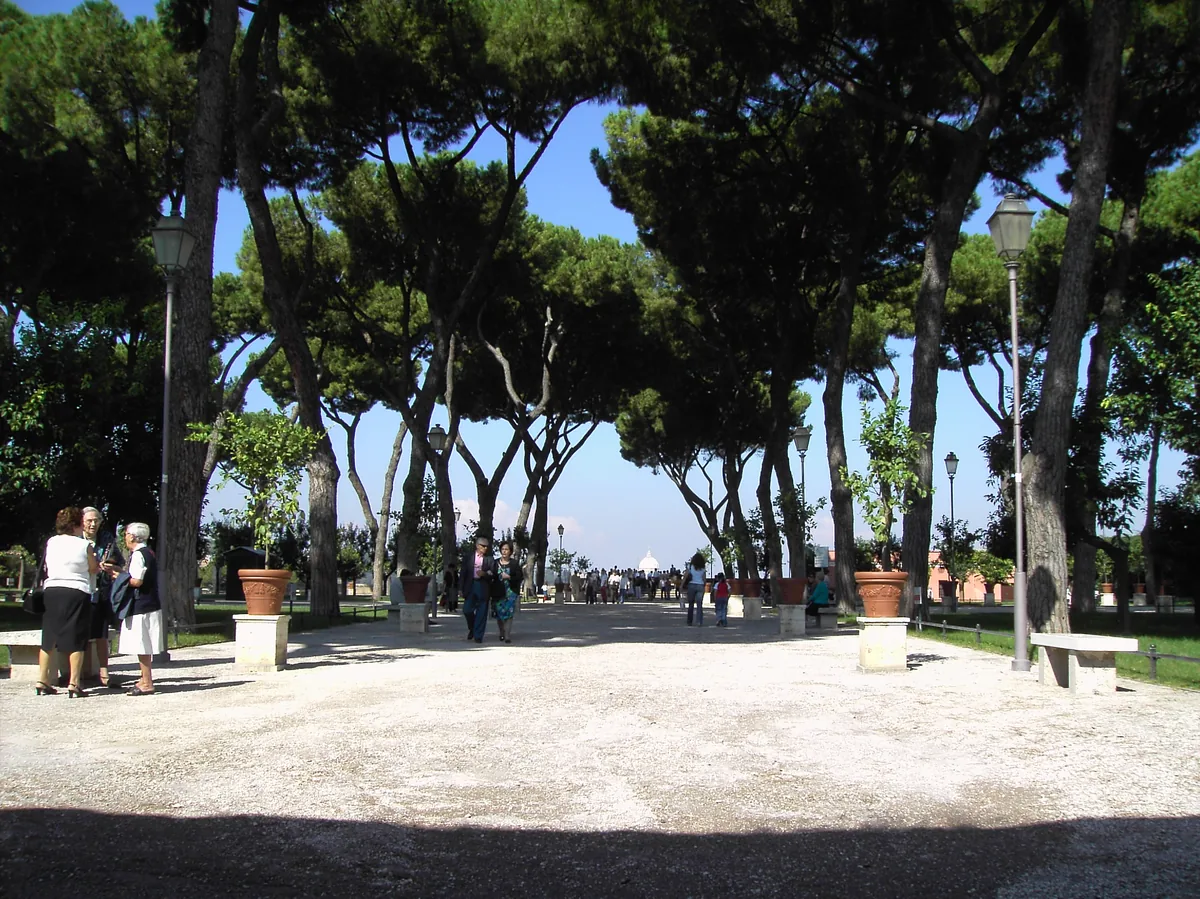
| Giardino degli Aranci | Proper benches | Full, under the orange trees |
| Pincio terrace | Benches along the balustrade | Good, with a view |
| Villa Borghese | Benches throughout | Dense |
The pattern holds across the city. Step one street off a famous square and the seating appears. Learn where those streets are on the way in, while nobody needs them yet.
Toilets, the unglamorous constraint
Public toilets in the centre are rare and inconsistent, so in practice people use cafés, museums and churches. The rule that works is a coffee stop every ninety minutes, chosen deliberately rather than urgently. An espresso standing at the bar costs a euro or two and buys you the facilities without any negotiation.
Building the day differently
The instinct is to shorten the list. That helps. The bigger lever is changing when you move and how you cover the ground in between.
Front-load the morning. Out by half past seven, three hours of real sightseeing, back inside before the heat and the crowds arrive together at eleven.
Take the afternoon off without guilt. Between May and September, one o'clock to four is not sightseeing time in Rome. It is lunch and a lie-down. The people who fight that lose the evening as well.
Arrive at hills from above. This is the single most useful trick in the city. The Aventine, the Gianicolo, Trinità dei Monti and the Pincio are all beautiful, all flat on top, and all steep to reach. Get up there by vehicle and you walk only the good part.
This is most of what our guests over seventy book us for: a seated route between the viewpoints, with the walking saved for the places that deserve it.
What a cart does and does not solve
It removes the transfers, and the transfers are where the kilometres pile up. A 2.5-hour route with six to nine stops leaves you with roughly nine hundred metres on foot, split into short stretches across the pedestrian squares.
Boarding is one step up, about the height of a car sill, with a grab handle to pull on. A walking stick travels fine. If you can get into a taxi, you can get into the cart.
It is not wheelchair accessible. There is no ramp and no lift. A folded chair rides behind the rear seat, but a guest who cannot transfer out of their chair cannot board, and we would rather tell you that today than at the pick-up.
It also does nothing for the inside of the Vatican Museums, which are about two kilometres of indoor walking with nowhere useful to sit down. If that visit matters to you, give it its own day and plan nothing else around it.
When to come
Late March to mid-May, and late September to early November. Mild air, long daylight, shorter queues. That last one counts for more than most people expect, because queuing is standing still on stone, and standing still is harder on most older visitors than walking is.
August is the hardest month by a wide margin: peak heat, peak crowds at the monuments, and half the neighbourhood restaurants shut. If August is your only window, read how to sightsee in Rome at 36°C before you build the itinerary.
The honest limit
Rome will still be more physical than most European capitals. There is no version of this city where you see the Forum without walking on rubble, or reach the Pantheon without crossing a pedestrian zone on your own feet. What you can control is where those hundred-metre stretches fall, and how much of the day's supply of steps goes on the sights rather than on the gaps between them.
On the Spanish Steps specifically, there is a way up that skips all 135 of them: Trinità dei Monti vs the Spanish Steps. And on why taxis stop short of so many addresses: Rome's ZTL explained.
Tell us what they can manage and we will tell you honestly whether the route works, including which stops we would drop. Private cart, pick-up at your hotel, €390 for one to three guests, €490 for four or five, €590 for six or seven.